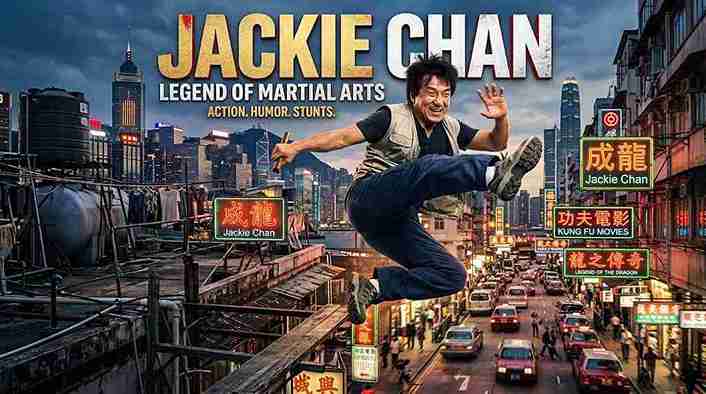
Jackie Chan Net Worth, Life Story, and the Jaw-Dropping Journey From Street Kid to Global Legend
Picture a seven-year-old boy in Hong Kong, sleeping on a thin mat inside a brutal opera school, already learning to flip, fight, and fall without flinching. That boy grew up to become Jackie Chan, the most recognizable action star on the planet and a man whose net worth now sits in the hundreds of millions.
If you’ve been scrolling through social media lately, you’ve probably noticed a fresh wave of Jackie Chan clips going viral — old stunt reels, behind-the-scenes bloopers, and emotional award speeches. Gen Z is discovering what older fans have known for decades: this man is one of a kind. So let’s break down everything you need to know about his money, his movies, and the wild life story that made it all possible.
Quick Profile & Social Media Snapshot
| Category | Details |
| Full Name | Chan Kong-sang (Stage Name: Jackie Chan) |
| Date of Birth | April 7, 1954 |
| Birthplace | Victoria Peak, British Hong Kong |
| @jackiechan — 32M+ followers | |
| TikTok | @jackiechan — 12M+ followers |
| X (Twitter) | @jackiechan — 8M+ followers |
| Career Peak | 1995–2010 (Rush Hour era, global crossover) |
| Estimated Net Worth (2025) | ~$400 Million |
| Key Popularity Driver | Self-performed death-defying stunts + comedy-action fusion |
Biography Table at a Glance
| Detail | Info |
| Nationality | Chinese (Hong Kong SAR) |
| Height | 5’8″ (173 cm) |
| Spouse | Lin Feng-jiao (married 1982) |
| Children | Jaycee Chan, Etta Ng Chok Lam |
| Professions | Actor, Director, Producer, Martial Artist, Singer, Philanthropist |
| Years Active | 1962–Present |
| Notable Awards | Honorary Academy Award (2016), MBE, Golden Horse Awards |
| Languages | Cantonese, Mandarin, English, Korean (conversational) |
Early Life: The Opera School That Built a Warrior
Jackie Chan was born Chan Kong-sang on April 7, 1954, in British Hong Kong. His parents, Charles and Lee-lee Chan, worked as a cook and housekeeper for the French ambassador. Money was tight. When the family briefly relocated to Australia for work, young Kong-sang stayed behind and enrolled at the China Drama Academy.
This was no ordinary school. Run by the notoriously strict Master Yu Jim-yuen, the academy trained children in Peking Opera — a punishing blend of acrobatics, martial arts, singing, and acting. Students woke before dawn, trained for up to 19 hours a day, and faced harsh physical punishment for the smallest mistakes.
Jackie Chan has spoken openly about those years. He credits the academy with giving him the discipline, pain tolerance, and physical genius that later defined his career. He also made lifelong friends there, including Sammo Hung and Yuen Biao, who would become his creative partners and fellow action legends.
By his late teens, the opera industry in Hong Kong was collapsing. Film was the new game, and Jackie Chan transitioned into the movie world as a stuntman and extra. He even doubled for Bruce Lee in “Fist of Fury” and “Enter the Dragon,” taking brutal hits on camera for barely any pay.
The Climb: From Flop to Box Office King
The early 1970s were rough. After Bruce Lee’s tragic death in 1973, studios scrambled to find “the next Bruce Lee.” Jackie Chan was pushed into that mold, given the stage name “Sing Lung” (Becoming the Dragon), and cast in a string of serious kung fu films that flopped hard.
Everything changed in 1978. Director Yuen Woo-ping cast him in “Snake in the Eagle’s Shadow” and then “Drunken Master.” These films let Jackie Chan do something revolutionary — he mixed slapstick comedy with jaw-dropping martial arts. Audiences went wild. He wasn’t a brooding warrior. He was the goofy underdog who got hit in the face, shook it off, and kept fighting.
The 1980s saw Jackie Chan take full creative control. He directed, wrote, and starred in masterpieces like “Project A,” “Police Story,” and “Armour of God.” The stunts grew more insane with every film. He slid down a pole wrapped in real lights. He jumped from a building onto a moving bus. He hung from a helicopter over a South African gorge.
Hollywood came calling in the mid-1980s, but early American attempts like “The Protector” and “The Big Brawl” underperformed. Jackie Chan went back to Asia, kept making hits, and waited for the right moment.
That moment arrived in 1995 with “Rumble in the Bronx,” which became a surprise smash in the United States. Three years later, “Rush Hour” paired him with Chris Tucker and turned Jackie Chan into a household name across the Western world. The film grossed over $244 million globally and spawned two sequels.
Jackie Chan Net Worth Breakdown (2025)
So how much is Jackie Chan actually worth? Most credible financial outlets peg his net worth at approximately $400 million as of 2025. That number comes from six decades of relentless work across multiple income streams.
Film Earnings and Box Office Numbers
Jackie Chan has appeared in over 150 films. His movies have collectively grossed more than $5 billion at the worldwide box office. During his peak Hollywood years, he commanded salaries between $15 million and $20 million per film. The “Rush Hour” trilogy alone generated over $800 million globally, and Jackie Chan negotiated backend profit participation deals that paid him long after the credits rolled.
Even as he shifted toward Chinese-language blockbusters in the 2010s, the money kept flowing. Films like “Chinese Zodiac” (2012) and “Kung Fu Yoga” (2017) pulled in massive numbers across Asian markets, where his star power remains unmatched.
Business Ventures and Endorsements
Jackie Chan’s wealth doesn’t come from movies alone. He owns Jackie Chan’s Kitchen, a restaurant chain with locations across Asia. He co-founded JCE Movies Limited, his own production company, which has produced dozens of profitable films. He also holds stakes in real estate developments in Hong Kong and mainland China, a market that has seen explosive growth over the past two decades.
His endorsement portfolio has included deals with Mitsubishi, Canon, and various Chinese consumer brands. At his peak endorsement years, these deals reportedly brought in $10 million to $15 million annually.
Royalties and Licensing
The “Kung Fu Panda” franchise, where he voices Monkey, has grossed over $1.8 billion worldwide. While his exact salary for those roles hasn’t been disclosed, voice work on a major animated franchise typically pays well into the seven figures. Add in merchandise licensing, DVD and streaming residuals, and music royalties from his 20-plus studio albums, and the passive income is substantial.
Career Earnings Comparison by Era
| Era | Key Films | Estimated Earnings | Primary Market |
| 1978–1989 | Drunken Master, Police Story, Project A | 20M–40M | Hong Kong & East Asia |
| 1990–1999 | Rumble in the Bronx, Rush Hour | 80M–120M | Global crossover begins |
| 2000–2010 | Rush Hour 2 & 3, Shanghai Knights, The Karate Kid | 150M–200M | Hollywood peak |
| 2011–2025 | Chinese Zodiac, Kung Fu Yoga, Ride On | 100M–150M | China & streaming |
Personal Life: Family, Scandals, and Philanthropy
Jackie Chan married Taiwanese actress Lin Feng-jiao in 1982. The couple has one son, Jaycee Chan, who pursued an acting and music career of his own before running into legal trouble in 2014 with a drug conviction in Beijing. That incident deeply affected Jackie Chan, who publicly apologized and spoke about the pressures of fame on young people.
In 1999, Jackie Chan acknowledged that he had fathered a daughter, Etta Ng Chok Lam, with former Miss Asia Pacific Elaine Ng Yi-Lei. The relationship and its aftermath became a massive tabloid story across Asia. Jackie Chan has since expressed regret about how he handled the situation, though his relationship with Etta remains complicated and largely private.
On the philanthropy side, Jackie Chan is one of the most generous celebrities in the world. He serves as a UNICEF Goodwill Ambassador and has donated millions to disaster relief, education, and wildlife conservation. He famously pledged to give away half of his fortune to charity when he dies, joining a growing movement of ultra-wealthy individuals committed to large-scale giving.
Industry Reactions and Lasting Legacy
Ask any action filmmaker working today about their biggest influence, and Jackie Chan’s name comes up almost every single time. Directors like Chad Stahelski (“John Wick”) and the Russo Brothers have publicly credited his choreography style as a major inspiration.
The Academy of Motion Picture Arts and Sciences agreed. In 2016, Jackie Chan received an Honorary Oscar for his “extraordinary lifetime achievements” in cinema. The standing ovation he received that night lasted nearly three minutes, with A-list actors like Tom Hanks, Michelle Yeoh, and Sylvester Stallone visibly moved.
Critics who once dismissed his films as lightweight comedy have reassessed his body of work. Film scholars now point out that Jackie Chan essentially invented a new genre — the action-comedy — and pioneered techniques like rapid-cut fight editing and the use of everyday objects as weapons. His outtake reels, played during end credits, changed how studios marketed action films and humanized the stunt process for global audiences.
Fans remain fiercely loyal. His social media posts regularly pull millions of views, and his older films consistently trend on streaming platforms. A 2024 poll by Rotten Tomatoes ranked “Police Story” among the greatest action films ever made, proving that his work ages remarkably well.
What’s Next for Jackie Chan?
At 71 years old, Jackie Chan shows no signs of fully stepping away. He continues to take on selective film roles, often shifting toward more dramatic and emotional characters. His 2023 film “Ride On” explored the bond between an aging stuntman and his horse, drawing comparisons to his own life and earning strong reviews across Asian markets.
He has also expressed interest in mentoring the next generation of action performers through his stunt training academy in China. Given his track record, it wouldn’t be surprising to see a new wave of Jackie Chan-trained talent hitting screens within the next few years