USB-C to USB: The Only Guide You Need for Fast Charging & Data
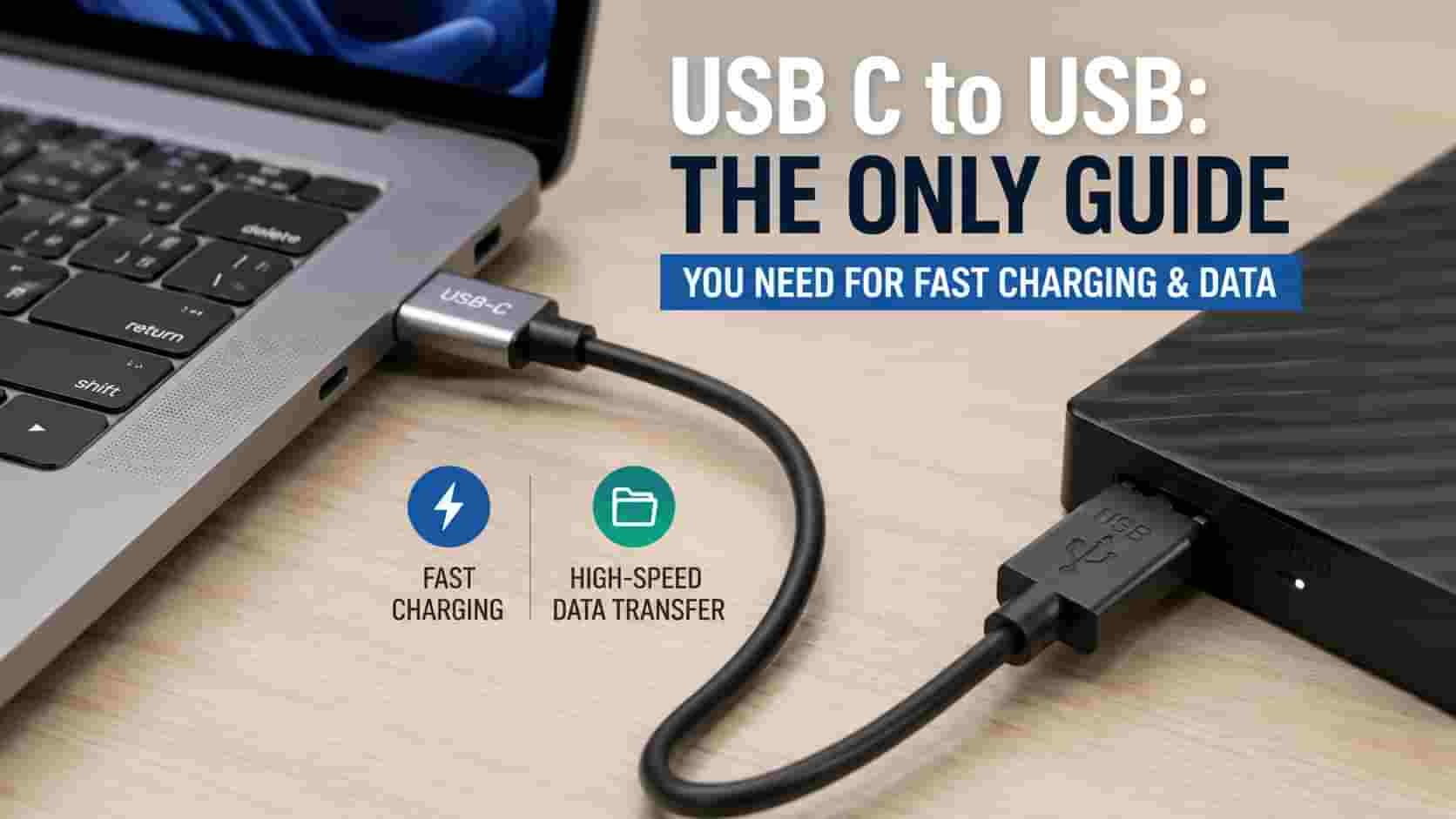
The shift from older rectangular USB-C to USB ports to the smaller, rounded USB-C connector has created a common problem: your new laptop or phone only has USB-C ports, but your printer, flash drive, or mouse still uses the classic USB-A connection. That is where a usb c to usb cable or adapter becomes your essential everyday tool. Choosing the right solution requires more than just matching the plug shape. Selecting the correct cable ensures you get the fastest possible charge and the highest data transfer speeds your devices can support .
What is a USB-C to USB Cable?
A usb c to usb cable is a connection solution designed to bridge two different generations of technology. On one end, you have a USB-C connector, which is the modern, 24-pin, reversible standard. On the other end, you have a standard USB-A connector, which is the large, rectangular, non-reversible plug that has been the industry standard for decades .
These cables are fundamentally backward-compatible, allowing you to connect legacy devices like older printers, mice, and keyboards to modern USB-C laptops . However, these cables are “dumb” and cannot support the advanced protocols that newer cables offer. They are limited by the older technology of the USB-A port, meaning they cannot transmit video signals, nor can they deliver the same high wattage for charging laptops as a USB-C to USB-C cable can .
Key Advantages: Why You Need This Connection
Moving to a usb c to usb connection provides a major advantage when adapting your workspace. It essentially future-proofs your older accessories, allowing you to use your reliable devices without the immediate need for costly upgrades. It eliminates the frustration of ports that only fit one way, offering the convenience of USB-C’s reversible design on one end while making it incredibly easy to move large files from old hard drives to new devices. Even when limited by USB-A speeds, these cables are far faster than older USB 2.0 connections, ensuring you can back up photos or transfer large documents in seconds .
How It Works: Data & Power Specifications
Data Transfer Speeds
The data transfer speed of a usb c to usb cable depends entirely on the USB version of the USB-A port and the cable’s construction. A high-quality version of this cable will support USB 3.2 Gen 1, offering SuperSpeed data transfers up to 5 Gbps . This is roughly 10 times faster than older USB 2.0 cables. While this is fast enough for most peripherals, it is significantly slower than the 40 Gbps speeds you can achieve with a USB-C to USB-C cable .
Charging Capabilities
When it comes to power, these cables are typically limited to 5V at up to 3A (15W) . This is sufficient for charging smartphones, headphones, and powering external hard drives. However, this power output is insufficient for charging resource-intensive devices like laptops, which require the higher voltage negotiation provided by USB-C Power Delivery .
Types of USB-C to USB Solutions
USB-C to USB-A Adapters
A simple adapter is the smallest, most portable solution. It converts a USB-C port into a USB-A port. It is perfect for connecting a single legacy device like a flash drive or a mouse directly to a new laptop .
USB-C to USB-A Cables
These are traditional cables with a USB-C plug on one end and a USB-A plug on the other. They are ideal for connecting your modern phone to an older car charger or for permanently hooking up a printer to a new computer .
USB-C Hubs with USB-A Ports
A hub expands a single USB-C port into multiple USB-A ports, and often includes other ports like HDMI or Ethernet. This is the best solution for desktop setups where you need to connect multiple peripherals (keyboard, mouse, external drive) simultaneously .
Choosing the Right Cable for Your Needs
Check Your Devices
Before purchasing a usb c to usb cable, identify the ports on your older and newer devices. If your device has a USB-C port, a cable with that connector will be required. If your older device has a USB-A port, the other end must be USB-A. For a simple connection, a direct cable is ideal, while a hub is better for a complex workstation .
Look for USB-IF Certification
Always look for certification from the USB Implementers Forum (USB-IF). This logo ensures the cable meets industry standards for safety and performance. Certified cables are far less likely to fail or, worse, damage your expensive devices .
Evaluate Build Quality
The physical build matters significantly. Look for cables with braided nylon jackets and reinforced connectors. Thicker cables often have better shielding, which protects against interference and helps the cable last longer .
| Feature | USB-C to USB-A Cable/Adapter | USB-C to USB-C Cable |
|---|---|---|
| Connector Type | USB-C on one end; USB-A on the other | USB-C on both ends |
| Primary Use | Connecting legacy devices to modern ports | Charging laptops; connecting modern monitors/docks |
| Max Data Speed | Up to 5 Gbps (USB 3.2 Gen 1) | Up to 40 Gbps (USB4/Thunderbolt) |
| Power Delivery | Limited to ~15W (5V/3A) | Up to 240W (for laptops) |
| Video Support | No (Audio/Video not supported) | Yes (DisplayPort Alt Mode) |
| Reversibility | USB-A end is not reversible | Both ends are reversible |
| Best For | Mice, keyboards, flash drives, printers | Monitors, docks, high-speed external SSDs, laptop charging |
How to Get the Fastest Speeds
To ensure you are getting the fastest possible speeds from your usb c to usb connection, you must check the USB version of your computer’s port. Older USB 2.0 ports will be limited to about 480 Mbps, while a USB 3.2 port is needed to achieve the full 5 Gbps. Similarly, ensure you are using a cable explicitly labeled for USB 3.0 or USB 3.2 speeds. A high-quality cable with a USB-C male to USB-A female adapter should support data transfer rates up to 5 Gbps . Keep in mind that this is a one-way street; you cannot use this cable to charge a USB-C laptop from a USB-A port, as the laptop expects a much higher wattage .
Common Issues and Troubleshooting
Device Not Recognized
If a device is not recognized, try flipping the USB-C connector. While USB-C is designed to be reversible, it relies on active negotiation for the connection. If that fails, connect the USB-C to a different port on your computer to rule out a hardware issue .
Slow Charging
If your phone is charging slowly, the USB-A port may be power-limited. Try connecting to a port labeled with a lightning bolt or a battery icon, as these often deliver higher power. It is also important to know that these adapters cannot charge laptops; they simply do not have the power delivery capability .
Data Transfer is Slow
Your cable may be limiting you if the transfer speed is slow. Always ensure you are using a cable rated for USB 3.0 to achieve maximum speeds. Standard USB 2.0 cables will cap the transfer rate at 480 Mbps .
Dropping Connection
A loose connection can be caused by dust or debris in the port. Carefully clean the port with compressed air. If the issue persists, the cable or port may be physically damaged and require replacement .
Frequently Asked Questions (FAQs)
Q: Are all USB-C to USB-A cables the same?
A: No. While they share the same shape, they differ significantly in data transfer speed (USB 2.0 vs. 3.0) and build quality. A cable rated for USB 3.0 supports speeds up to 5 Gbps, while a USB 2.0 cable is limited to 480 Mbps .
Q: Can a USB-C to USB-A adapter charge my laptop?
A: Rarely. Most USB-A ports are limited to 5V/3A (15W) output. This is not enough to power a laptop, which typically requires 30W to 100W. These adapters are generally used for data transfer and powering small devices like phones or mice .
Q: Can I use this cable to connect my new computer to an old monitor?
A: Probably not. Standard usb c to usb adapters do not support video/audio signal transmission . To connect to a monitor, your adapter must specifically support DisplayPort Alt Mode over USB-C, which is rare for USB-A adapters.
Q: Will a USB-C to USB-A adapter work with my printer?
A: Yes. Printers typically use USB-B ports, but the cable connecting the printer to the computer usually terminates in a USB-A connector. A usb c to usb adapter will allow you to plug that standard USB-A cable into a new USB-C laptop .
Q: Are USB-C to USB-A adapters safe to use?
A: Yes, if they are made by a reputable manufacturer. Poorly made cables can cause electrical issues. Look for USB-IF certification to ensure the adapter has the proper internal resistors and safeguards to protect your devices from power surges .
Q: What is the difference between an adapter and a hub?
A: An adapter (or dongle) typically provides one single USB-A port. A hub expands a single USB-C port into multiple USB-A ports (and sometimes other ports like HDMI or Ethernet), allowing you to connect several devices simultaneously .
Conclusion
The journey to a fully modernized setup often requires bridging the gap between old and new technology. A usb c to usb cable or adapter is a simple, affordable, and highly effective tool for connecting your legacy devices to the latest laptops and tablets. It is the essential link that empowers you to continue using your reliable peripherals. You now have the knowledge to select the right one for your needs.